Run the agent in your network
Register in the UI, run register once, then keep start running. All traffic is outbound—no inbound access to your databases.
$ ./aimo_agent.sh start
Schema to monitors · rows stay local
Catch bad loads, silent drift, and schema surprises at the source—before they train your AI models or reach the dashboards, board decks, and customer-facing numbers built on the same tables. Caught early it’s a quiet fix; surfacing later as a wrong prediction or a blown report, it’s a scramble. Walk through setup ↓
Why it matters
Bad numbers don’t stay in the warehouse. They train your AI models, feed your dashboards, and end up in the board deck, the invoice, and the decision. AIMO catches them while they’re still cheap to fix—before a long pipeline buries the error where no one thinks to look.
AI you can trust
Training a model—or feeding any AI pipeline—takes accurate data, and those pipelines run through many steps before a result comes out. A bad input rarely trips an alarm; it quietly skews what the model learns and resurfaces as a confidently wrong answer no one can trace back. AIMO checks the data at the source, so what you build on it holds up.
Confident decisions
Every dashboard, forecast, and board report is only as reliable as the tables behind it. AIMO flags broken data before it shapes a decision—so you’re not steering on a figure that quietly went wrong last Tuesday.
Fewer fire drills
A bad batch caught at the source is a quiet fix. The same error in a customer invoice or a quarterly report is an all-hands scramble—and a dent in trust. AIMO moves the catch upstream of your reputation.
Safe to adopt
Most monitoring tools mean handing a vendor your data. AIMO doesn’t: raw rows never leave your environment, so there’s nothing new to leak and far less for security and legal to review before you say yes.
See it in action
Schema monitoring
Discovery for onboarding; ongoing tracking as pipelines and migrations change your tables.
AI-assisted monitoring
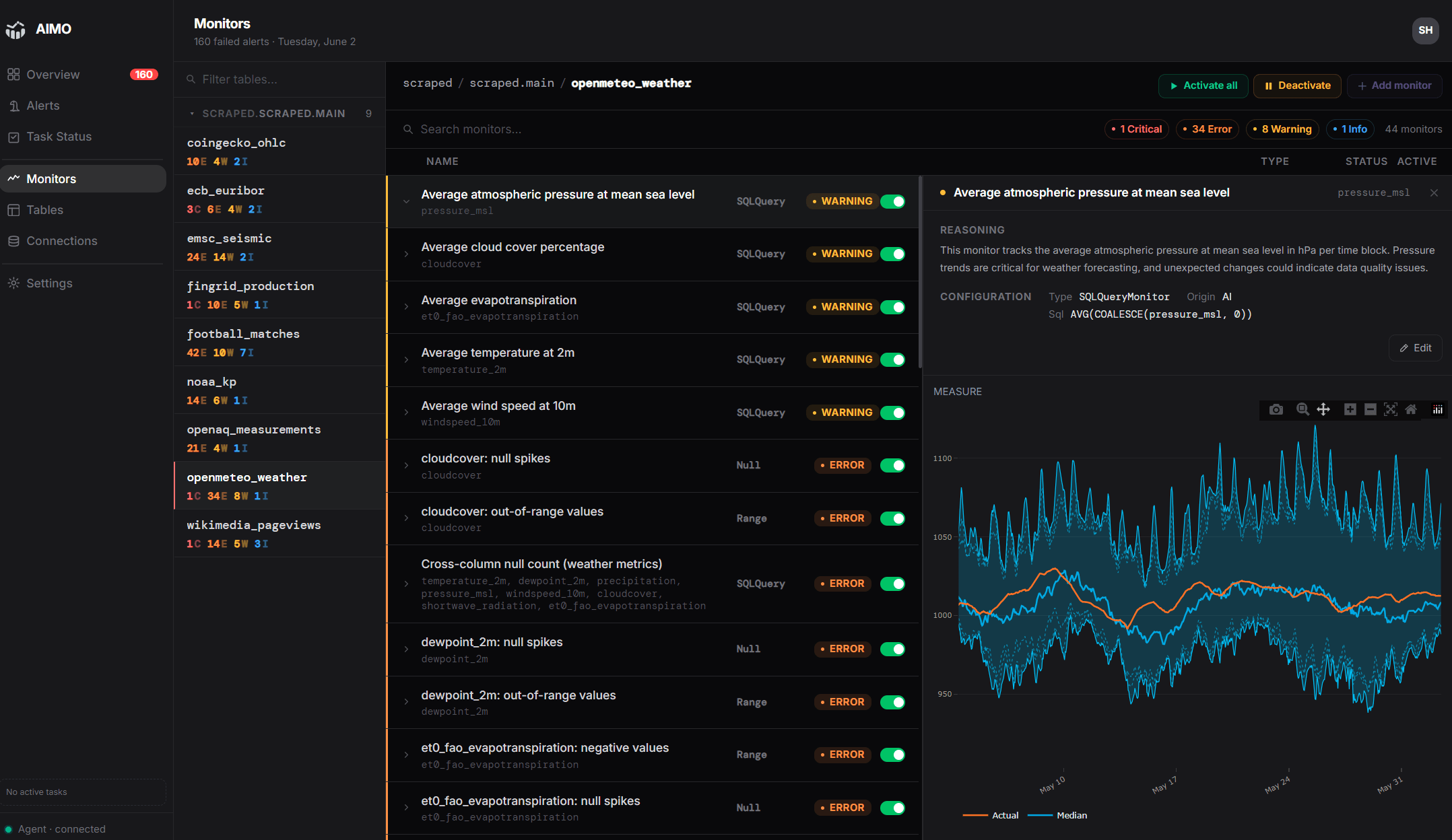
You choose which tables to onboard. AIMO generates the monitors—types, columns, and bounds—from its analysis of your schema and data, and explains its reasoning. Each one is a typed, validated definition that runs as a bounded query against your database.
Privacy by design
Monitoring sends summaries and monitor outputs—counts, grouped results, schema fingerprints—not table copies. Outlier models run on those series in the cloud, while the rows themselves never move.
Architecture
One outbound-only agent beside your databases. AIMO dispatches typed jobs; the agent runs bounded queries locally and returns aggregates. There is no path from our cloud to your SQL port.
Capabilities
Surprise nulls in critical columns—caught immediately.
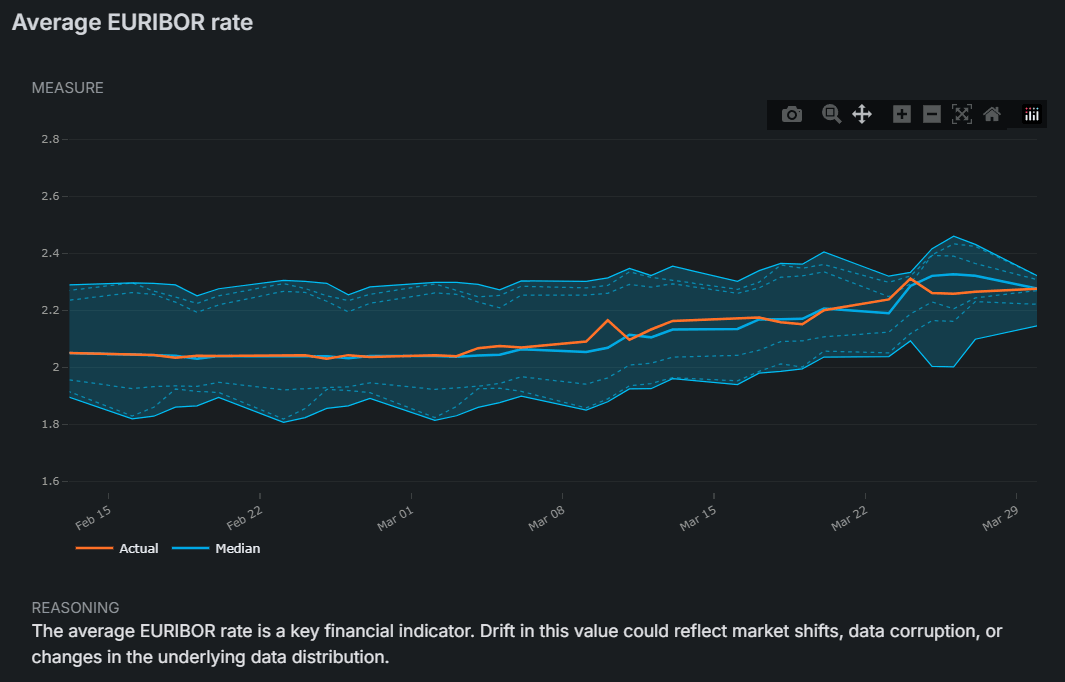
Flags values outside assigned min/max; outlier detection spots unusual count behavior over time.
When built-ins aren’t enough, SQLQueryMonitor runs one custom aggregate in the same grouped shell—bounded, not a free SQL session.
Alerting
Email alerts today, routed by severity—with more destinations added regularly.
Multi-database
SQLAlchemy-backed—broad engine support; extend with drivers.
Fixed job types only—analyze, monitors, validate, test connections. No arbitrary cloud code beside your data.
3 tables free for 1 month · then €10 / table / month (excl. tax)
See pricing →Security & privacy
Credentials via agent CLI, encrypted before upload. DB access decrypts on the agent—not in browser or plaintext in our API.
The agent queries your databases from inside your own network. Only aggregates and monitor results leave—never raw rows or PII.
Secrets encrypted on the agent before upload. We store ciphertext; agent decrypts only for jobs beside your data.
Per-agent keypair; cloud holds the public key. Agent proves possession for short-lived JWTs on REST and job socket—no static API password.
Jobs deserialize to known models. SQL on your side comes from validated monitor definitions—not free-form strings in the envelope.
Human access to the web UI uses passkeys (WebAuthn) only—there is no password to phish, reuse, or leak.
Operated from Finland. A signed Data Processing Agreement, named sub-processors, and your GDPR rights are documented in Legal.
Where it fits
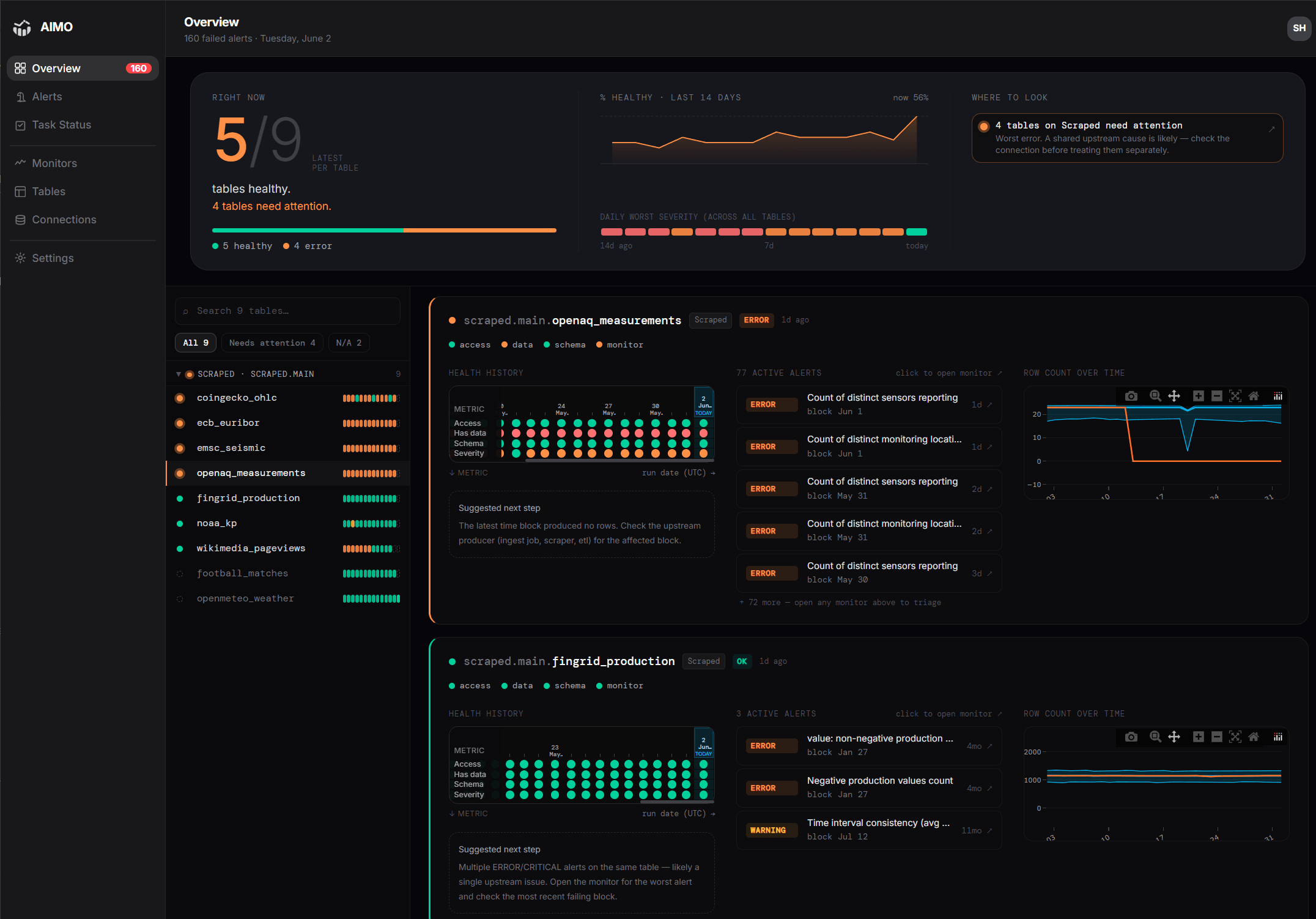
Track orders, events, subscriptions—drift, null spikes, range issues. Catch bad loads before dashboards fail.
Watch keys, status distributions, and schema changes from deploys—and catch them before they corrupt downstream reports. All without exporting rows.
Run checks right after each load, so a bad batch is caught at the source—not three dashboards later.
Why AIMO
Getting started
register → live monitors on your tables.
Register in the UI, run register once, then keep start running. All traffic is outbound—no inbound access to your databases.
Add connections through the agent CLI, not the browser. Credentials are encrypted on the agent before upload—we only ever store ciphertext.
Run analysis from the UI and pick the tables that matter. Profiling runs on the agent; only metadata and aggregates reach AIMO—never raw rows.
Accept, and AIMO generates the monitors, backfills history, and trains outlier detection on each series. Alerts fire on aggregate shifts, not one-off rows.
Alerts arrive by email today, with more destinations added regularly.
FAQ
Sign in, register in UI, run register once, add connections in the agent CLI, run start, then analyze and onboard in the UI. After accept, monitors assign and backfill—time scales with data size.
PostgreSQL, MySQL, SQLite, Snowflake, DuckDB, and more—see docs for the list.
You pick which tables to onboard and accept. AIMO then uses AI to generate the monitor types, columns, and bounds from its analysis of your schema and data.
Routine monitoring does not export bulk raw rows. The agent sends metadata and aggregates—counts, grouped results, analysis payloads—for dashboards and models. Details: security, architecture.
On your schedule, AIMO dispatches monitor jobs to the agent. Same bounded queries as artifact validation.
After month one: €10/table/month (excl. tax). Add or remove in UI—billing updates next cycle.
More on data quality monitoring: read the complete guide, the glossary, and the full FAQ.
From the founder
“For years I watched data teams say ‘we should really have data quality monitoring’—and never get to it, because setup took months and someone had to hand-write every check. AIMO is the tool I wished existed: it reads your tables, generates the monitors, learns what normal looks like, and never copies your data out.”
Sami Hanhijärvi · PhD · Founder, AIMO (Motify Data Mining)
Get started
Register, CLI connection, onboard—monitors and outliers on up to three tables free month one. Aggregates cross the wire, not bulk raw rows.